How AI Support Goes Wrong Without API Grounding
AI support becomes risky when it cannot see your API contract, error behavior, telemetry, or customer context. Grounding turns vague chatbot replies into support answers developers can trust.

Fluent Answers Are Not the Same as Correct Answers
Ungrounded AI support can sound helpful while sending developers in the wrong direction. A customer reports a 401, a webhook retry loop, a failed embedding job, or a broken search integration, and the assistant responds with generic advice because it cannot see the API contract, logs, auth model, or recent customer context.
That is the core failure mode. The AI is fluent, but it is not operationally aware. It does not know which endpoint exists, which scopes are required, which errors are expected, which environment the customer is using, or whether the documentation has drifted from production behavior.

The API Contract Has to Be in the Loop
Most bad AI support experiences come from missing grounding. The assistant has a help center article, a few macros, and maybe a product overview, but it does not have endpoint-level evidence. It cannot connect a developer's question to the exact method, path, request body, response shape, status code, or auth requirement that matters.
When that context is missing, the support experience turns into a guessing game. The bot asks the customer to retry, clear a cache, check credentials, or read a generic article. Meanwhile, the actual issue might be a missing scope, a stale SDK example, a malformed webhook signature, an exceeded rate limit, or a payload that changed after a version update.
- Endpoint claims should trace back to a current API source.
- Auth guidance should know the relevant scheme, scope, and environment.
- Error explanations should map to documented behavior or verified runtime evidence.
- Customer-specific issues should hand off when the evidence is not enough.
Generic Error Advice Wastes Developer Time
API error handling is where ungrounded AI support fails fastest. Developers do not need a cheerful summary of what a 500 means in general. They need to know why this request failed, what evidence points to the cause, and which next action has the highest chance of resolving it.
A grounded support system should help distinguish between caller mistakes, product bugs, dependency failures, environment mismatches, rate limits, and authentication problems. That requires structured context: request ids, timestamps, endpoints, status codes, response bodies, retry behavior, and known incidents or limitations.
- For 401s, verify token format, scopes, environment, and expiration before blaming credentials.
- For 429s, explain rate-limit windows, retry-after behavior, and backoff guidance.
- For 4xx validation errors, point to the exact field, schema, or payload expectation.
- For 5xx failures, separate customer-side retries from vendor-side escalation.
AI Search Problems Need Pipeline Context
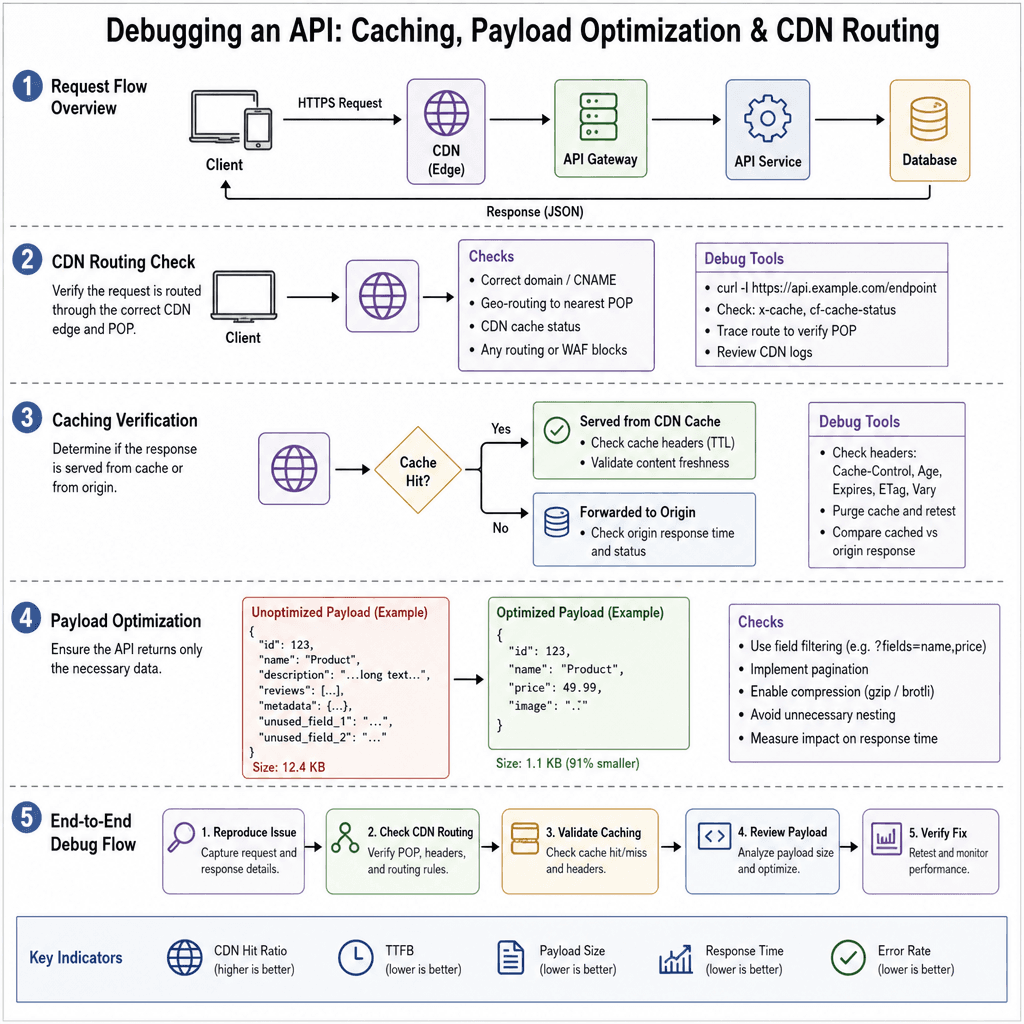
Search, indexing, embeddings, and LLM workflows make the grounding problem more visible. A semantic search failure may involve crawler access, source freshness, token limits, embedding sync, index connectivity, payload size, or rate limiting. A generic AI assistant cannot diagnose those layers from a static article.
The support system needs to understand the pipeline. What source was ingested? When was it last indexed? Did the embedding job fail? Was the API throttled? Are search results stale because the index is behind, or because the source content is missing? Without that operational context, the answer will sound confident but stay shallow.
- Monitor index freshness and ingestion failures.
- Capture failed embedding or sync jobs with actionable error metadata.
- Track latency and rate-limit pressure on APIs that feed search or AI answers.
- Show operators which source evidence was retrieved before the answer was generated.
Docs and Live Support Need to Work Together
Good documentation is still essential, but documentation alone is not the same as grounded support. Docs explain intended behavior. Support often has to handle what happened in a specific account, request, environment, or deployment window.
The right model connects documentation, API references, recent source scans, customer conversation history, and safe runtime checks. When the docs are enough, AI can answer with citations. When the issue depends on private account state or live system behavior, the system should collect the right details and route the case to a human.
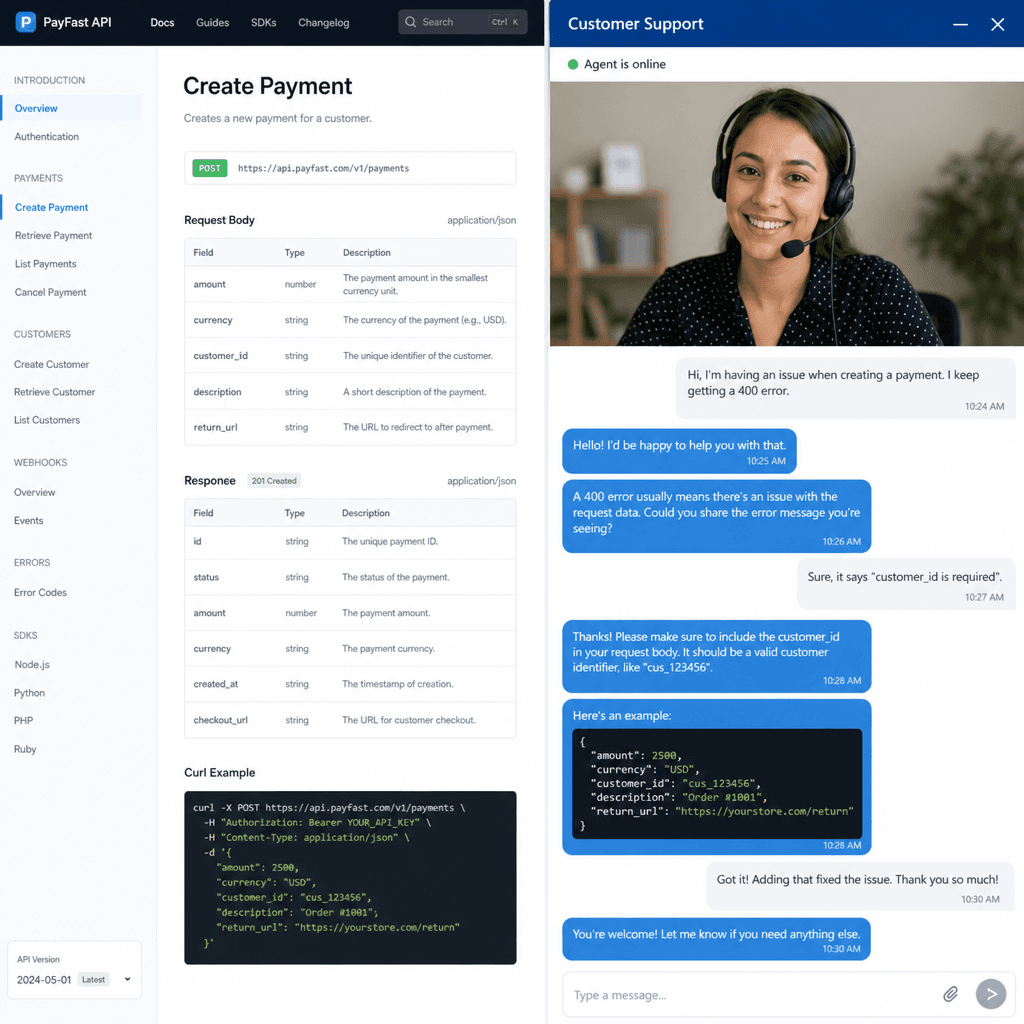
Confidence Gates Protect Developer Trust
A reliable AI support workflow needs confidence gates. If the assistant cannot find a relevant source, if the source is stale, if the customer's environment is unclear, or if the question requires account-specific action, it should not improvise. It should ask one focused clarifying question or hand off.
The handoff should include the customer question, relevant transcript, retrieved sources, suspected failure mode, missing information, and suggested next step. That makes human support faster rather than making the customer repeat the entire debugging story.
- Ask for request ids, timestamps, environments, SDK versions, or payload snippets when they change the answer.
- Hand off immediately for production outages, billing/security-sensitive actions, or unclear account state.
- Show operators what the AI retrieved and why it did or did not answer.
- Use skipped answers as a signal that docs or source coverage need improvement.
How to Build AI Support That Actually Helps
The practical fix is not to remove AI from support. It is to make AI answer from the same evidence a strong operator would inspect. That means ingesting API sources, preserving endpoint-level detail, redacting secrets, tracking source freshness, and keeping conversations tied to one customer timeline across chat, email, and community channels.
It also means measuring more than deflection. Teams should track wrong-answer risk, handoff quality, repeated issue categories, documentation gaps, and whether grounded answers actually reduce the next wave of tickets.
- Normalize OpenAPI, docs, Postman examples, SDK notes, and troubleshooting guides into support context.
- Keep credentials separate from source content and redact sensitive values before model calls.
- Use authenticated testing carefully to verify safe claims when the workspace allows it.
- Review low-confidence cases and turn repeated patterns into docs, examples, or product fixes.
The Bottom Line
AI support goes wrong when it is asked to answer operational API questions without operational API evidence. The result is generic troubleshooting, missed root causes, weak escalations, and developers who no longer trust the support surface.
Grounding changes the shape of the workflow. The assistant can answer when the evidence is strong, clarify when one fact is missing, and hand off with useful context when a human needs to take over. That is how AI becomes a support teammate instead of a support bottleneck.
Sources and Standards
This Woes article references public standards and developer documentation that shape API support workflows.
Related Woes Pages
Continue into the Woes product pages that connect this topic to API-native support workflows.