Back to blog
Operations

How Discord Support Fits Developer Communities

Discord is where many developer communities surface integration pain first. Treating it as a support channel keeps that context connected to the inbox, AI agent, and human handoff.
July 2, 20268 min read
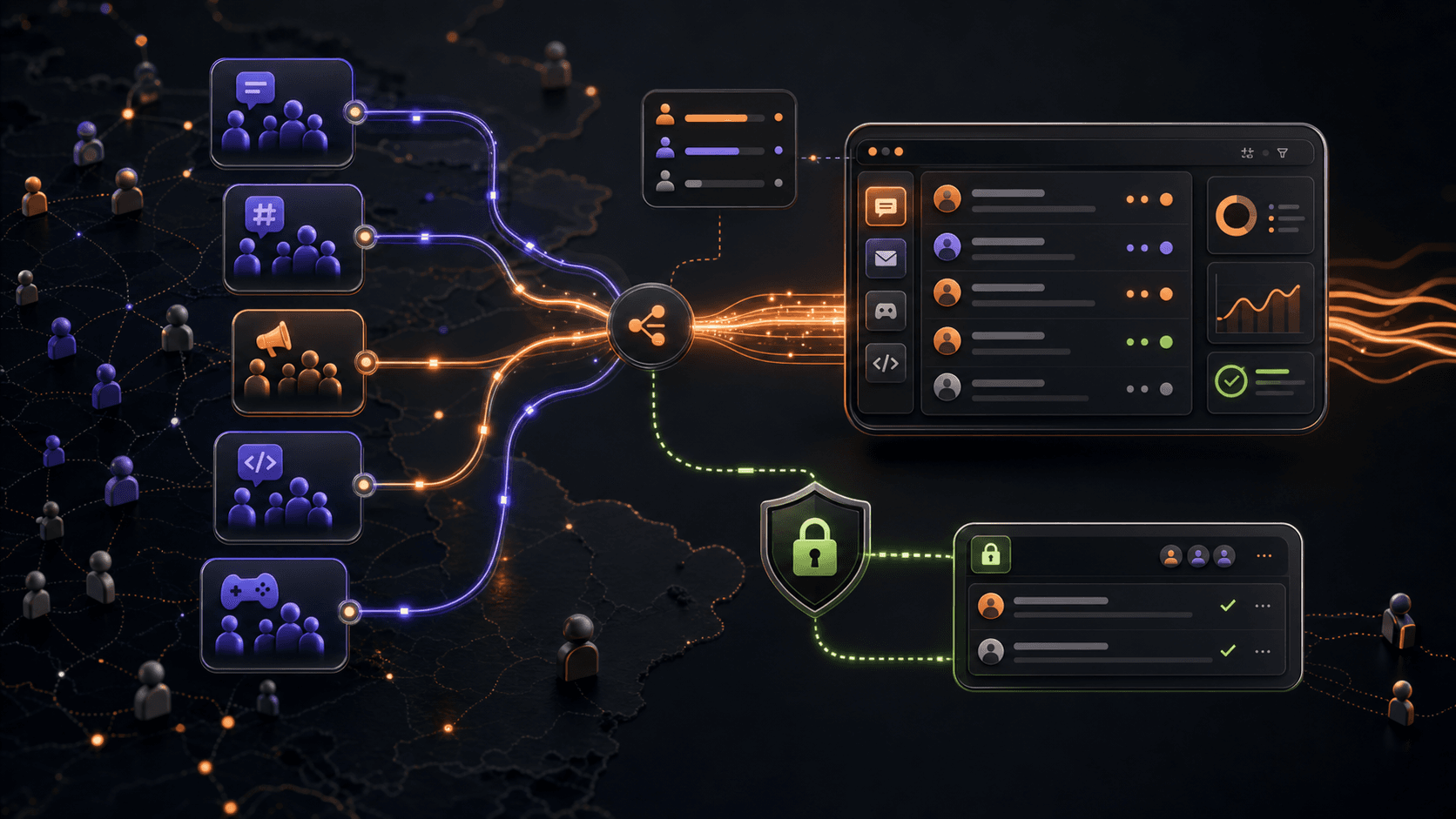
Discord community messages flowing into a unified developer support inbox with AI and operator context.

Community Questions Are Often Support Signals

Developer communities often surface support problems before they become tickets. A customer posts a quick question, another developer adds context, and an operator may need to turn the thread into a real support workflow.

That is why Discord should be treated as a support channel, not a separate support product. The community shape matters, but the underlying work still needs customer context, evidence, assignment, AI handoff, and resolution tracking.

Keep the Channel Context, Unify the Work

The support system should preserve Discord context without flattening every community message into a private ticket. Operators need to know where the question came from, whether it is public or private, who participated, and whether the issue needs a follow-up in chat or email.

When Discord is part of the same conversation model as live chat and email, the support team can keep one timeline and one set of operating rules instead of building a Discord-only queue.

  • Keep channel metadata visible to operators.
  • Route support-worthy threads into the same inbox model.
  • Preserve community context without exposing private customer details.
  • Use handoff when a public thread needs human judgment.

Ground AI Before It Replies in a Community

AI can help in Discord only when it has evidence. If the question is about an endpoint, auth requirement, SDK example, or webhook behavior, the agent should retrieve workspace context before answering. If the evidence is missing, a clarification or human handoff is safer than a confident guess.

That grounding rule is especially important in community spaces because wrong answers can spread quickly. The support workflow should make source evidence and operator takeover part of the Discord path.

Discord support works best when community speed is paired with support-grade evidence.

Use Community Patterns to Improve Support Context

Discord support patterns should feed the same improvement loop as chat and email. Recurring questions can reveal missing docs, unclear onboarding, weak SDK examples, or source gaps. Those patterns are hard to see if community support lives outside the operator workflow.

Once Discord is part of the same support model, teams can measure which topics repeat, where AI helps, where humans take over, and which source updates reduce future noise.

Sources and Standards

This Woes article references public standards and developer documentation that shape API support workflows.

Related Woes Pages

Continue into the Woes product pages that connect this topic to API-native support workflows.

Keep reading

More from Woes

API Support

How to Reduce Repeated API Support Questions

Repeated API questions usually mean the support system cannot see the same contract developers are trying to use. Reducing those tickets starts with better context, routing, and feedback loops.

Read article
API Context

How to Turn OpenAPI Docs Into Support Answers

OpenAPI can become more than reference documentation. With the right normalization, it gives support teams endpoint-level evidence for AI answers, operator review, and live troubleshooting.

Read article
API Context

How Postman Collections Can Become Support Context

Postman collections often contain the examples support teams wish the docs had. Turning them into support context helps operators and AI agents answer from concrete request evidence.

Read article
API Context

How GraphQL Schemas Should Be Used in Developer Support

GraphQL support depends on schemas, fields, query shape, auth behavior, and examples. The schema needs to become support evidence, not just developer reference material.

Read article
API Context

How GitHub Docs Become AI Support Context

Repository docs, SDK examples, changelog notes, and troubleshooting files can become AI support context when they are scoped, cleaned, and connected to the support workflow.

Read article
Operations

Live Chat vs Email vs Discord for Developer Support

Live chat, email, and Discord each solve a different developer support job. The support system should preserve those channel strengths while keeping one customer and conversation model.

Read article
Operations

How to Triage API Integration Issues

API integration issues are easier to resolve when support teams triage by the technical fact the customer is missing: endpoint, auth, payload, environment, webhook, SDK, or account state.

Read article
Operations

How Support Teams Should Manage API Documentation Gaps

Documentation gaps show up as repeated support questions, low-confidence AI answers, and operator handoffs. Support teams need a workflow for turning those signals into better source context.

Read article
AI Support

When AI Support Should Hand Off to a Human

Human handoff is not where AI support fails. It is how a responsible support agent preserves trust when evidence is missing, the issue is risky, or a customer needs a person.

Read article
Developer Support

API Support Needs a Context Layer, Not Another Chatbot

Developer support fails when every channel sees a different version of your API. The fix is not another generic bot, it is a shared context layer built around the contract your customers actually integrate with.

Read article
Operations

Designing a Unified Inbox for Live Chat, Email, and Discord

Support teams should not have to choose between live chat speed, email depth, and Discord community presence. The channels are different doors into one customer problem.

Read article
AI Support

Grounded AI Support Needs Verification and Human Handoff

Grounded AI support is not just retrieval plus a friendly response. It needs evidence, redaction, confidence gates, verification paths, and a human handoff that operators can trust.

Read article