How AsyncAPI Becomes Support Context for Event-Driven APIs
AsyncAPI can give developer support teams a precise map of channels, operations, messages, and schemas. Learn how to turn that contract into evidence for event-driven API troubleshooting.

AsyncAPI Support Context Connects the Contract to the Incident
AsyncAPI support context starts with a problem that request-response documentation does not solve. A developer reports that an event never arrived, arrived twice, failed validation, or reached the wrong consumer. There may be no single HTTP request and response to inspect. The useful evidence is spread across the producer, broker, channel address, message envelope, payload schema, consumer, retry policy, and deployment environment.
An AsyncAPI document can organize much of that contract in a machine-readable form. It describes message-driven APIs without assuming one transport, so the same model can cover technologies such as Kafka, MQTT, AMQP, WebSockets, or HTTP-based messaging. For support teams, the opportunity is larger than rendering attractive reference pages. The contract can become a navigable evidence map that helps an operator or grounded agent identify what should send, what should receive, which message is valid, and which missing runtime fact must be requested next.
That transformation is not automatic. A technically valid document can still omit the examples, direction, server details, correlation clues, and operational expectations that make a support answer useful. The goal of this architecture explainer is to show how to turn AsyncAPI channels and messages into support context without pretending a static contract can prove live delivery behavior.
Event-Driven API Support Needs a Different Mental Model
REST troubleshooting often begins with a method, URL, status code, and response body. Event-driven systems replace that compact exchange with a chain of independent decisions. A producer may successfully publish while the broker rejects the message later. A broker may accept it while a subscription filter excludes it. A consumer may receive it, fail deserialization, retry, and eventually move it to a dead-letter destination. Each stage can be healthy in isolation while the developer still experiences a missing business outcome.
That is why an event-driven support question should not be flattened into a generic endpoint question. The support surface needs to preserve topology and direction. It should distinguish the application described by the document from the other participants, the logical channel identifier from its physical address, and the message definition from the operation that sends or receives it. It should also keep protocol-specific bindings visible when they materially affect delivery.
A useful investigation therefore asks which application is in scope, which environment and server it uses, which operation it performs, which channel carries the message, which message variant applies, and what observation proves the event reached each boundary. AsyncAPI supplies the contract side of those answers. Broker telemetry, application logs, delivery identifiers, and safe runtime checks supply the incident side.
Model the AsyncAPI Contract as a Support Graph
The strongest support representation is a graph rather than a blob of YAML. Start with servers, channels, operations, and messages as separate nodes. A server establishes where and over which protocol communication is expected. A channel establishes the addressable path through which messages move. An operation establishes what the documented application does. A message establishes headers, payload, content type, correlation information, examples, and schema rules.
Preserve the links between those nodes during ingestion. When a developer asks why an order event was not consumed, retrieval should not return an unrelated message merely because both documents contain the word order. It should retrieve the receive operation, its referenced channel, the supported message definitions, the applicable server, and adjacent troubleshooting prose. That bundle is narrow enough to answer precisely and complete enough to expose what is still unknown.
Channel parameters deserve the same treatment. An address such as `orders/{region}/created` is not one literal topic. The parameter determines the actual route, so support needs the parameter name, allowed or example values, and where that value comes from. If the report involves one tenant, region, device, or account, a channel parameter mismatch can explain why a valid message traveled somewhere the intended consumer never observed.
- Server evidence: environment, host or URL, protocol, security expectations, and relevant bindings.
- Channel evidence: stable identifier, physical address, parameters, supported messages, and server availability.
- Operation evidence: send or receive direction, application perspective, message subset, traits, and reply behavior.
- Message evidence: headers, payload schema, content type, correlation ID, examples, and deprecation state.
Normalize Direction Without Losing the AsyncAPI Version
Direction is a common source of confident but wrong support answers, especially when a team mixes AsyncAPI versions. In AsyncAPI 2.x, `publish` and `subscribe` operations sit inside a channel item, and their meaning is defined from the perspective of the application described by the document. That vocabulary has historically caused confusion because readers may instinctively interpret it from the broker or outside consumer perspective.
AsyncAPI 3 decoupled channels, messages, and operations. Operations now live at the root, reference a channel, and use an `action` of `send` or `receive` to state what the documented application does. The migration guide identifies this decoupling as a major breaking change. Version 3 also separates a channel's document key from its physical `address`, which makes reuse clearer but gives ingestion systems another relationship to preserve.
Support tooling must therefore record the AsyncAPI version and normalize direction deliberately. It should never silently translate `publish` into send or receive using intuition. If an ingestion path supports one document shape more deeply than another, the source detail should expose the coverage instead of presenting an optimistic ready state. Operators need to know whether they are looking at a complete operation map or only a source overview.
The practical rule is simple: always phrase direction with an explicit subject. Say that the documented application sends the event, receives the event, or exposes a channel for another participant. A sentence such as the event is published is too ambiguous to anchor a troubleshooting decision.
Make Messages Answerable, Not Merely Valid
A payload schema can prove that a field is required or constrained, but support questions rarely end at structural validity. Developers also need to know what an event means, when it is emitted, which participant owns it, how it evolves, and what they should do after receiving it. Those semantics belong in summaries, descriptions, examples, tags, external documentation, and message traits surrounding the schema.
Examples are especially valuable because they turn abstract types into a concrete diagnostic comparison. A good example includes realistic headers and payload values, satisfies the schema, and demonstrates optional or polymorphic branches that routinely confuse consumers. JSON Schema's `examples` keyword is an annotation rather than a validation rule, so teams should validate their examples in CI instead of assuming that documentation tooling will reject a stale sample.
Correlation deserves first-class treatment too. AsyncAPI can describe a correlation ID location for a message. That gives support a safe question to ask: which non-secret correlation or delivery identifier can trace this event through producer, broker, and consumer records? If a system uses CloudEvents, the required `source` and `id` attributes have defined uniqueness semantics that can also help identify duplicates. CloudEvents explicitly leaves broader workflow correlation to additional data, so support should not overload the event ID with a meaning the contract does not promise.
- Document why and when the message exists, not only its field types.
- Keep at least one valid example for every important message variant.
- Describe versioning and compatibility expectations near the schema.
- Identify a safe correlation path that does not require secrets or full customer payloads.
Trace One Event Across Contract and Runtime Boundaries
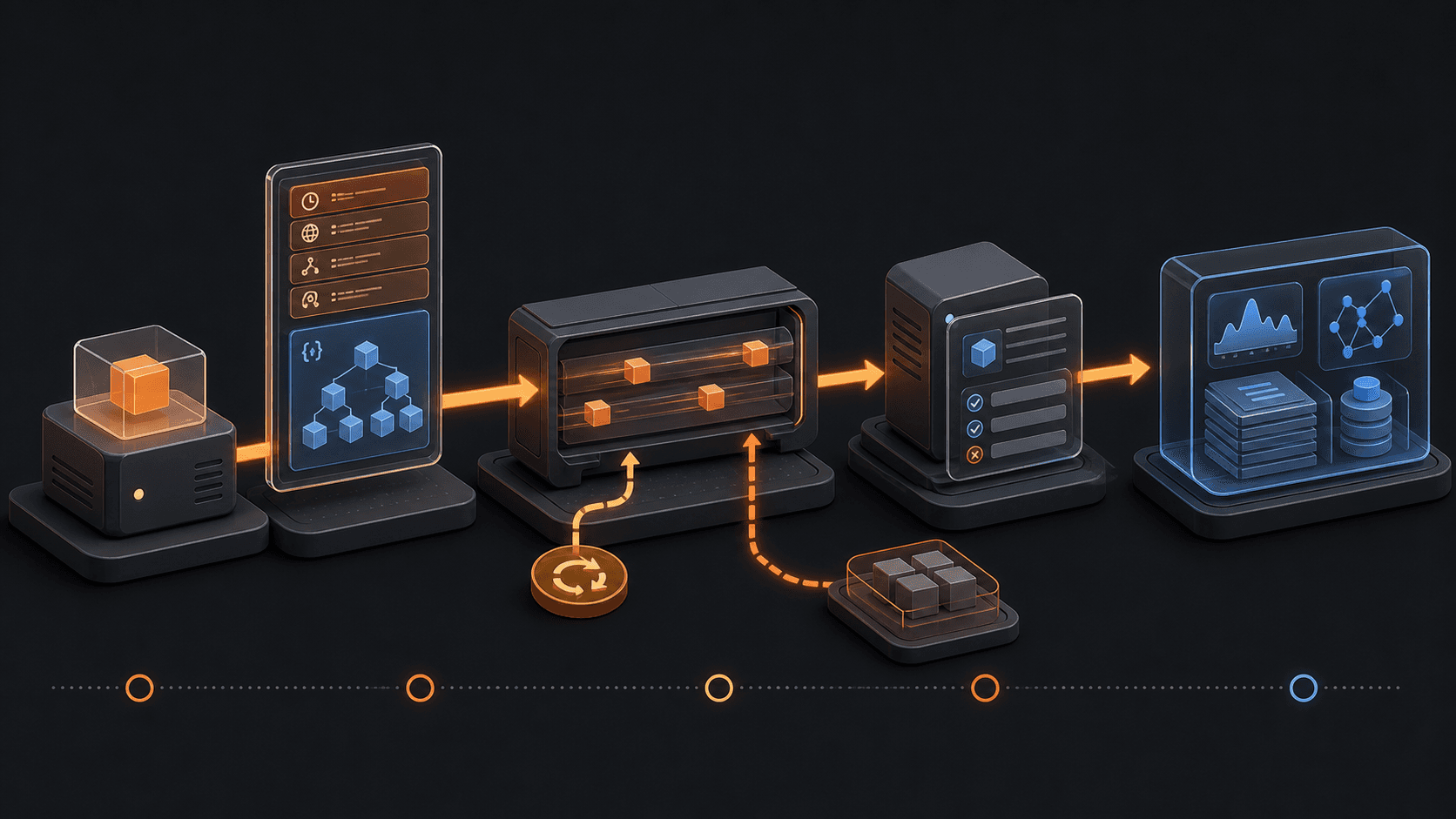
A support-ready contract should mirror the checkpoints an event crosses. At the producer boundary, evidence includes the operation, message choice, serialized payload, content type, channel address, and a non-sensitive event identifier. At the broker boundary, evidence includes acceptance, routing, partition or subscription selection, retry state, and any dead-letter outcome. At the consumer boundary, evidence includes receipt, deserialization, schema validation, idempotency handling, and the resulting business action.
The AsyncAPI specification is protocol-agnostic, while bindings carry protocol-specific details. That separation is useful for support because it prevents a Kafka partition question from being answered with generic MQTT assumptions. The core contract can explain the message and channel; the binding and runtime evidence explain how that contract travels over the selected infrastructure.
Message validation belongs at a named boundary. The AsyncAPI message-validation guide describes validation in producers, consumers, schema registries, or gateways. Those placements do not fail in the same way. If a producer validates before sending, an invalid message may never reach the broker. If only the consumer validates, broker acceptance does not imply application acceptance. A useful support answer names where validation occurred and which schema version performed it.
Apply an Ingestion Quality Gate Before Retrieval
Before an AsyncAPI source is trusted for support, review its coverage like a product surface. Count the channels, operations, and messages that were actually normalized, then compare those counts with the source document. Spot-check references, examples, parameterized addresses, server associations, and message variants. A green upload indicator is not enough if the parser retained the title but dropped the operations an answer depends on.
Version-aware coverage matters here. A v2 document with channel-local operations and a v3 document with root operations represent related concepts through different structures. A support platform should either normalize the relevant version correctly or make the limitation visible. The safe operational response to partial coverage is to repair, convert, split, or supplement the source before enabling high-confidence automation around it.
Freshness is another gate. An accurate event contract from six releases ago can produce a beautifully cited wrong answer. Store the source version and rescan time, connect the document to its owning service, and trigger review when a message schema or channel changes. Repeated support reports about an undocumented event are themselves evidence that the source needs maintenance.
- Compare indexed counts with the source rather than relying on parser intent.
- Open several operations and confirm their channels, direction, messages, and servers remain connected.
- Test reference resolution and examples for the message variants that generate the most support work.
- Treat missing operations, stale schemas, and ambiguous direction as coverage failures, not harmless metadata gaps.
How Woes Uses AsyncAPI Support Context Today
Woes accepts AsyncAPI as a workspace-scoped API context source. The current implementation detects structured JSON or YAML as AsyncAPI when it finds an `asyncapi` version string and a channels object. For the classic channel-local shape, it indexes `publish` and `subscribe` operations as operation records, retains channel descriptions and parameters, summarizes referenced or inline messages, records server details, and reports channel, operation, and message counts.
Those normalized records become support context rather than a separate customer-facing channel. They can be retrieved alongside documentation prose and other API sources for an operator or the grounded support agent. The agent is instructed to identify whether evidence came from AsyncAPI, and the wider Woes behavior still applies: weak or incomplete evidence should lead to a clarification or human handoff instead of an invented channel, payload field, or delivery guarantee.
There is an important version boundary to verify. Woes's current AsyncAPI operation extraction follows the channel-level `publish` and `subscribe` structure used by AsyncAPI 2.x. AsyncAPI 3.1 places `send` and `receive` operations at the document root. Teams ingesting that newer shape should inspect the indexed operation count and retrieved detail before relying on operation-level answers. The presence of an AsyncAPI title or channel count alone does not prove full v3 operation coverage.
Woes also keeps credentials separate from source content and treats source ingestion as untrusted input. That means an AsyncAPI document can describe servers and security expectations without becoming a place to store live broker secrets. This boundary is essential: documentation helps support understand the contract, while credential handling and any guarded runtime verification remain controlled backend concerns.
Retrieve an Investigation Bundle, Not a Keyword Match
Once the source passes its coverage review, design retrieval around investigation bundles. A question about a missing `user.created` event should retrieve the relevant operation, channel address, message definition, server or environment notes, and a troubleshooting page if one exists. A question about a payload rejection should prioritize the message schema, content type, examples, and version notes. A question about duplicates should surface identifier and idempotency guidance rather than only the happy-path event description.
Confidence should reflect the evidence actually present. A matching channel name is not enough to state that an event was delivered. A matching schema is not enough to state why a consumer rejected it. The system can answer contract questions directly when the contract is clear, but runtime questions usually require a delivery ID, timestamp, environment, broker observation, or sanitized error. Asking for one of those details is better support than filling the gap with a plausible story.
Human handoff should preserve the same evidence graph. The operator needs the customer's reported outcome, the contract nodes already retrieved, the unanswered runtime question, and any safe diagnostic identifier. That package prevents the human from restarting the interview and makes it easier to distinguish a documentation gap from an application or infrastructure incident.
Turn Event Support Patterns Into Contract Maintenance
The long-term value of AsyncAPI support context is the feedback loop it creates. Tag each resolved conversation with the contract element that mattered: channel, operation, message, schema field, server, or binding. Then classify whether the source was correct, incomplete, stale, ambiguous, or difficult to retrieve. This turns support volume into a prioritized documentation backlog without treating ticket deflection as the only success metric.
A cluster of payload questions may justify stronger descriptions and valid examples. Repeated direction confusion may justify migrating a v2 document, adding application-perspective language, or improving generated reference pages. Missing-event investigations may reveal absent channel parameters, environment notes, retry behavior, or dead-letter guidance. Schema-version incidents may justify compatibility notes and automated example validation.
Measure quality with evidence-oriented signals: the share of relevant operations with descriptions and examples, reference-resolution success, source freshness, indexed-versus-declared coverage, clarification rate, and the number of answers operators correct because context was incomplete. Those measures improve the contract and the support system together. A raw count of ingested messages says little about whether the next developer will get an accurate answer.
Build AsyncAPI Support Context One Verified Flow at a Time
AsyncAPI becomes useful support context when it preserves relationships. Servers locate the interaction, channels route it, operations establish direction, messages define the exchange, schemas constrain data, and examples make those constraints concrete. Runtime evidence then confirms what happened during one delivery. Removing any of those layers increases the chance that an operator or AI agent will answer a different question from the one the developer asked.
Start with one important event flow and make its contract complete. Confirm the document version, name the application perspective, describe the physical channel address, connect every operation to its supported messages, add valid examples and correlation guidance, and document where validation and retries occur. Ingest it, compare indexed coverage with the source, and test retrieval using real support questions before expanding to the rest of the event catalog.
That approach keeps automation grounded and gives humans a better investigation map. The goal is not to make every event incident answerable from a specification alone. It is to make the contract precise enough that support can state what should happen, identify what evidence is missing, and move quickly toward the boundary where reality diverged from the documented design.
Sources and Standards
This Woes article references public standards and developer documentation that shape API support workflows.
Related Woes Pages
Continue into the Woes product pages that connect this topic to API-native support workflows.