Cross-Channel Support SLA: An Operating Model for Chat, Email, and Discord
Design a cross-channel support SLA that preserves the speed of chat, the depth of email, and the community context of Discord without splitting ownership.
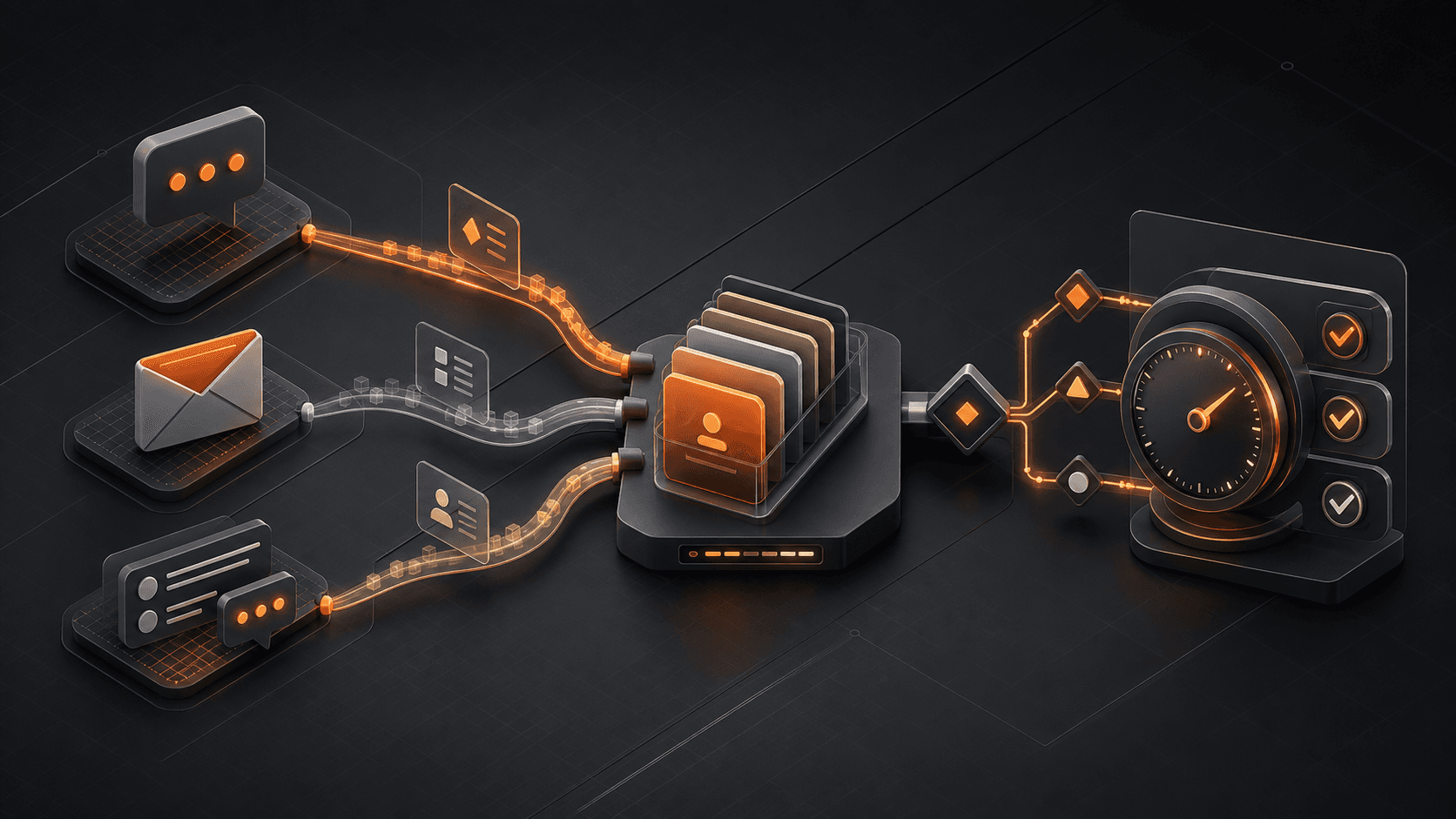
A Cross-Channel Support SLA Needs One Case Contract
A cross-channel support SLA is an operating contract for how a team acknowledges, advances, and resolves a customer case regardless of whether it arrived through live chat, email, or Discord. The channel affects the interaction, but it should not quietly determine whether the customer receives ownership, useful updates, or a verified outcome.
That distinction matters in developer support. A one-line chat may hide a production authentication failure. A detailed email may be routine implementation guidance. A Discord message may expose a widespread SDK regression before anyone opens a formal case. If the team assigns urgency from the door rather than the impact, fast channels consume attention while serious asynchronous cases age unseen.
The practical goal is not one identical timer for every message. It is one case policy with explicit clocks, severity rules, business hours, ownership transfers, privacy boundaries, and breach actions. This guide builds that model without pretending the three channels have the same ergonomics.
Separate the Indicator, Objective, and Agreement
Start by separating three terms that support teams often collapse. Google SRE defines a service level indicator as a quantitative measure, an objective as a target for that measure, and an agreement as a commitment with consequences. In support, first meaningful response time is an indicator. A target for a percentage of urgent cases is an objective. A promise in a customer contract, with stated remedies or escalation rights, is an SLA.
Many teams use SLA as shorthand for an internal response target. That is workable inside the queue, but the external document must be precise. If no commercial, operational, or other consequence follows a miss, label the target an SLO or support goal. Legal and account teams should own contractual language; support operations should own definitions, measurement, staffing assumptions, and evidence.
Keep the service promise separate from the API's availability SLO. A platform can be available while one customer's credentials, webhook signatures, or account state block an integration. Conversely, support can answer quickly during a broad outage without restoring service. Those are related control systems, not interchangeable numbers.
Define the Clocks Before Choosing the Targets
A usable cross-channel support SLA needs at least three clocks. First response measures the interval from accepted intake to the first customer-visible, meaningful reply. Next response measures the oldest unanswered customer follow-up to the next meaningful reply. Resolution measures the case lifecycle to a defined outcome. Zendesk documents the same distinction among first reply, next reply, update, and resolution metrics, and warns that teams do not need every available metric in every policy.
Write each clock as an event specification rather than a dashboard label. Name the start event, qualifying stop event, support calendar, exclusions, reopen behavior, data source, and owner. Decide whether an automated reply can satisfy the clock. A receipt that only says the message arrived should normally confirm delivery without satisfying meaningful response. A grounded answer that restates the issue, provides verified next steps, and exposes a human path may qualify under a clearly documented policy.
Resolution needs the strictest definition. Closed by an operator, no recent reply, workaround delivered, root cause repaired, and customer-confirmed recovery are different outcomes. Choose one that matches the promise and retain a resolution-evidence field so the status is auditable.
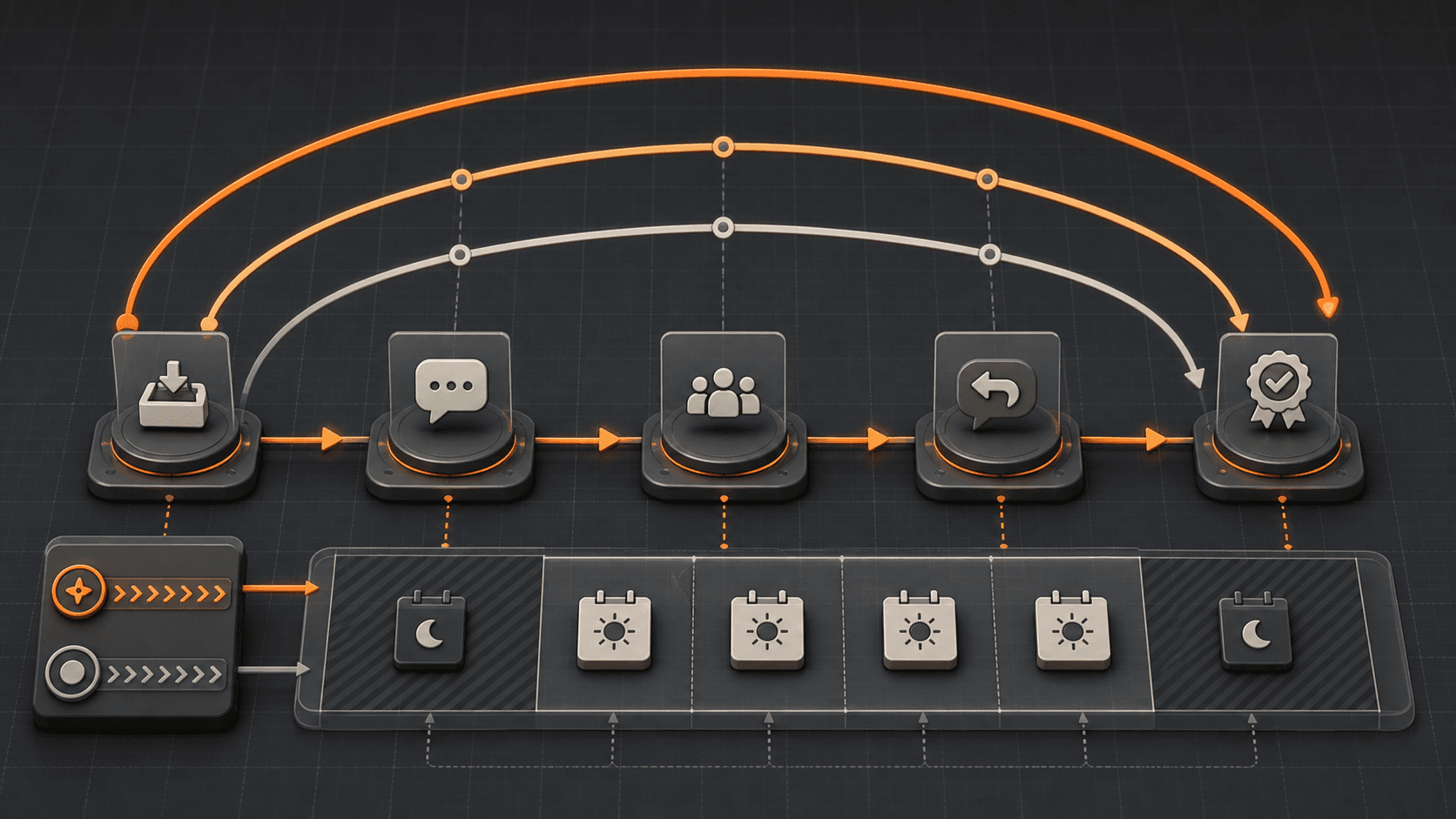
- First response: intake to a qualifying customer-visible reply.
- Next response: oldest unanswered customer update to a qualifying reply.
- Resolution: intake or assignment to a defined verified outcome.
- Update cadence: optional promise to communicate while investigation continues.
Require a Meaningful Response, Not a Timer-Stopping Receipt
A fast empty response is not good service. Define the minimum content of a meaningful first response: a faithful statement of the reported impact, an owner or team, the next diagnostic action, the safe evidence needed from the developer, and a time for the next update. For an API failure, that may mean asking for an environment, timestamp, request identifier, SDK version, sanitized status and error body, or minimal reproducible request. It should never mean asking for an API key or an unredacted production payload.
The same rule protects AI-assisted support. An answer should count only when the evidence supports its material claims and the customer knows what to do next. When context is weak or the question depends on runtime state, a clarification or human handoff can be the correct meaningful response. Fluency, message length, and the appearance of confidence are not service-level indicators.
Audit a sample of replies each month. If acknowledgments satisfy the timer while customers still wait for ownership, the metric is being gamed even if the calculation is technically correct. Pair response adherence with reopens, customer effort, correction rate, and verified resolution evidence.
Route by Impact Instead of Channel Urgency
Severity should come from impact, scope, risk, and available workaround, not from whether a developer chose chat. A practical taxonomy begins with a small number of levels. Critical covers active security, privacy, data-integrity, financial, or broad production-availability risk. High covers major production degradation or a blocked critical integration without a reasonable workaround. Normal covers a bounded integration failure or product defect. Low covers guidance, requests, and non-blocking questions.
Make the classification observable. Ask which environment is affected, how many users or requests are involved, whether data or money is at risk, whether a workaround exists, and when the problem began. Do not allow a customer-selected urgent label to bypass verification indefinitely, but do not make verification a barrier to initial ownership. Reclassify as evidence changes and retain the reason.
Set targets only after measuring volume and staffing by severity and hour. The correct P1 response goal for a staffed 24/7 enterprise program may be impossible for a weekday-only team. Publishing an aspirational number does not create coverage; it creates predictable breaches and teaches customers that the promise is decorative.
- Critical: immediate risk containment and named incident ownership.
- High: rapid technical triage and a scheduled update cadence.
- Normal: business-hours response and an explicit investigation plan.
- Low: planned guidance with transparent queue expectations.
Preserve the Semantics of Chat, Email, and Discord
Live chat creates a strong expectation of presence. Use it for quick qualification, safe evidence collection, and active troubleshooting. When the investigation will outlast the session, tell the developer who owns it, where durable updates will appear, and when the next update is due. Moving to asynchronous work should change the interaction mode, not erase elapsed time.
Email is durable but depends on correct threading. RFC 5322 defines Message-ID as a unique message identifier and uses In-Reply-To and References to identify replies and conversation threads. Preserve those fields, inbound and outbound timestamps, participants, and delivery state. A subject-line match alone is too weak for an auditable case clock, and a forwarded message may need explicit association rather than automatic merging.
Discord adds public visibility, community participation, permissions, and thread lifecycle. Discord documents that public threads inherit parent visibility, private threads require membership or moderation access, and threads may archive after inactivity. Treat archive state as a channel condition, not a resolution signal. A public acknowledgment can confirm ownership, but credentials, private account data, security evidence, or sensitive logs should move to an authenticated private path.
Write Start, Pause, Stop, and Reopen Rules
Every clock needs explicit start, pause, stop, and reset rules. Atlassian's service-management guidance treats goals, working hours, calendars, and start, pause, and stop conditions as separate configuration choices. That is the right level of rigor even if the team implements the policy elsewhere.
Start when the support system has accepted a support-worthy case, not when a connector happened to poll. Pause only for a named condition the customer can understand, such as waiting for specifically requested information, and decide whether critical incidents are ever pausable. Stop first response on a qualifying public reply, next response on a qualifying reply to the oldest unanswered customer message, and resolution on the chosen evidence-backed outcome.
Define reopen behavior before the first dispute. A customer reply that proves the fix failed should usually reactivate response and resolution accountability. Duplicate messages, channel retries, bot events, internal notes, and assignment changes should not create fresh customer promises. Preserve the event ledger so operators can explain every transition.
Make Business Hours and Incident Coverage Explicit
Business-hours targets are legitimate when the support offer is explicit. Configure the calendar with a named time zone, working windows, holidays, and exception coverage. Publish whether a target counts wall-clock or support-clock minutes. A message arriving Friday evening should not surprise either the customer or the Monday operator.
Use account-specific calendars only when contracts or support plans require them. Too many calendars make policy selection difficult to test and staffing difficult to reason about. Keep one default, add bounded exceptions, and test daylight-saving transitions, overnight shifts, holidays, and cases opened outside the window.
Critical security and production incidents may need a separate 24/7 intake path. NIST SP 800-61r3 frames incident response as an organization-wide cybersecurity risk-management activity rather than a support-queue detail. The support SLA should name the bridge into incident response, but it should not pretend that an ordinary queue timer replaces containment, coordination, recovery, or post-incident work.
Transfer Ownership Without Resetting Accountability
A handoff transfers work; it should not manufacture a new customer clock. Record the previous owner, receiving owner or team, transfer time, reason, evidence already gathered, unanswered question, next action, and next customer update. The receiving team needs a visible acceptance step so assigned does not become a euphemism for unattended.
Use internal operational-level objectives for team pickup when engineering, security, billing, or an account team joins. The external next-response promise still belongs to support unless the customer contract says otherwise. That separation prevents an internal transfer from pausing communication while specialists investigate.
AI-to-human handoff follows the same rule. Preserve the customer question, retrieved sources, confidence or insufficiency reason, citations safe for the customer, and any operator-only diagnostic context in the proper boundary. Do not make the developer repeat everything because the participant changed.
Turn Breaches Into an Operational Control Loop
A breach is an event that needs a response plan, not just a red badge. Before the deadline, notify the owner with the case impact, remaining time, missing evidence, and recommended next action. At breach, escalate to a named queue or lead, add an internal record, and decide whether the customer should receive a transparent update. Repeated breaches should trigger capacity or policy review rather than louder notifications.
Measure distributions and attainment, not only averages. A low mean can hide a long tail of abandoned cases. Report the percentage within target by severity, account plan, business-hour regime, owner, and channel, then review small samples for correctness. Channel cuts help find delivery or workflow problems; they should not become excuses for weaker service.
Keep denominator rules visible. Exclude spam, test traffic, and unsupported requests through explicit classifications. Do not silently remove breached cases, merge them away, or close them for inactivity. Track reopened cases and policy changes so a target revision does not rewrite history.
How Woes Supports Cross-Channel SLA Operations
Woes models live chat, email, and Discord as channel values over workspace-scoped support conversations, keeping channel metadata visible while operators work from a shared inbox model. Current workspace settings support enabled SLA policies for issue or team scope, first-response, next-response, and resolution targets, optional support-hour counting, and conditions based on account, priority, or team. Team-scoped measurement begins from recorded team assignment when that timestamp exists.
The SLA measurement path selects the matching policy, applies the relevant support-hour schedule, reads a stamped first response or transcript, evaluates subsequent customer messages for next response, and measures open or closed resolution time. The automation scheduler can record distinct first-response, next-response, and resolution breach kinds, fire SLA-breach workflows, and avoid re-firing an already recorded kind. Analytics exposes per-conversation measurements and adherence views.
These controls implement support operations; they do not create a legal promise automatically. A workspace owner still needs to define meaningful-response rules, severity policy, supported channels, calendars, incident escalation, contractual consequences, and audit practice. Woes also keeps the grounded support agent inside the same conversation model, but insufficient API evidence should still produce clarification or human handoff rather than an endpoint, auth rule, or production claim invented to meet a timer.
Roll Out the Model in 30 Days
In week one, inventory every support entry point and trace one case from intake to resolution. Define first response, next response, update cadence, resolution, reopen, and duplicate behavior. Select a four-level impact taxonomy and identify the fields needed to classify it safely.
In week two, establish a baseline without publishing contractual targets. Compare support-clock and wall-clock results, inspect tail cases, validate email threading and Discord permissions, and sample whether timer-stopping replies were meaningful. Fix missing timestamps and ambiguous status transitions before optimizing the numbers.
In week three, choose a small policy set, configure the default calendar and justified exceptions, assign owners, and test handoffs. Run tabletop cases for a Friday-night production failure, an unanswered email follow-up, an archived Discord thread, an AI clarification, a customer-wait pause, and a reopened defect.
In week four, enable pre-breach and breach workflows, publish customer-facing expectations, and review the first cohort daily. Treat misses as evidence about staffing, routing, policy, documentation, or product reliability. Tighten the targets only after the system can explain its calculations and the team can meet them without gaming.
Make the Promise Follow the Case
A strong cross-channel support SLA does not promise that every channel feels the same. It promises that every accepted case receives a clear severity, an accountable owner, meaningful responses, a transparent clock, safe evidence handling, and a defined outcome. Chat can remain immediate, email durable, and Discord community-native while the operating contract stays coherent.
Begin with definitions rather than target numbers. Measure one case timeline, preserve channel events, make business hours visible, carry accountability through handoffs, and pair adherence with answer quality and verified resolution. Only then should the team turn an internal objective into a customer agreement.
That order protects both sides. Developers know what will happen after they ask for help, and support teams can distinguish a real service miss from an unclear clock or an impossible promise. The result is not merely faster replies; it is a support system that remains trustworthy when a conversation changes channel, owner, or technical depth.
Sources and Standards
This Woes article references public standards and developer documentation that shape API support workflows.
Related Woes Pages
Continue into the Woes product pages that connect this topic to API-native support workflows.