Build vs Buy a Developer Support Platform: A Decision Framework
Use this build-versus-buy framework to compare developer support platforms, custom infrastructure, and hybrid designs across cost, control, security, and operational fit.
Build vs Buy a Developer Support Platform as a System Decision
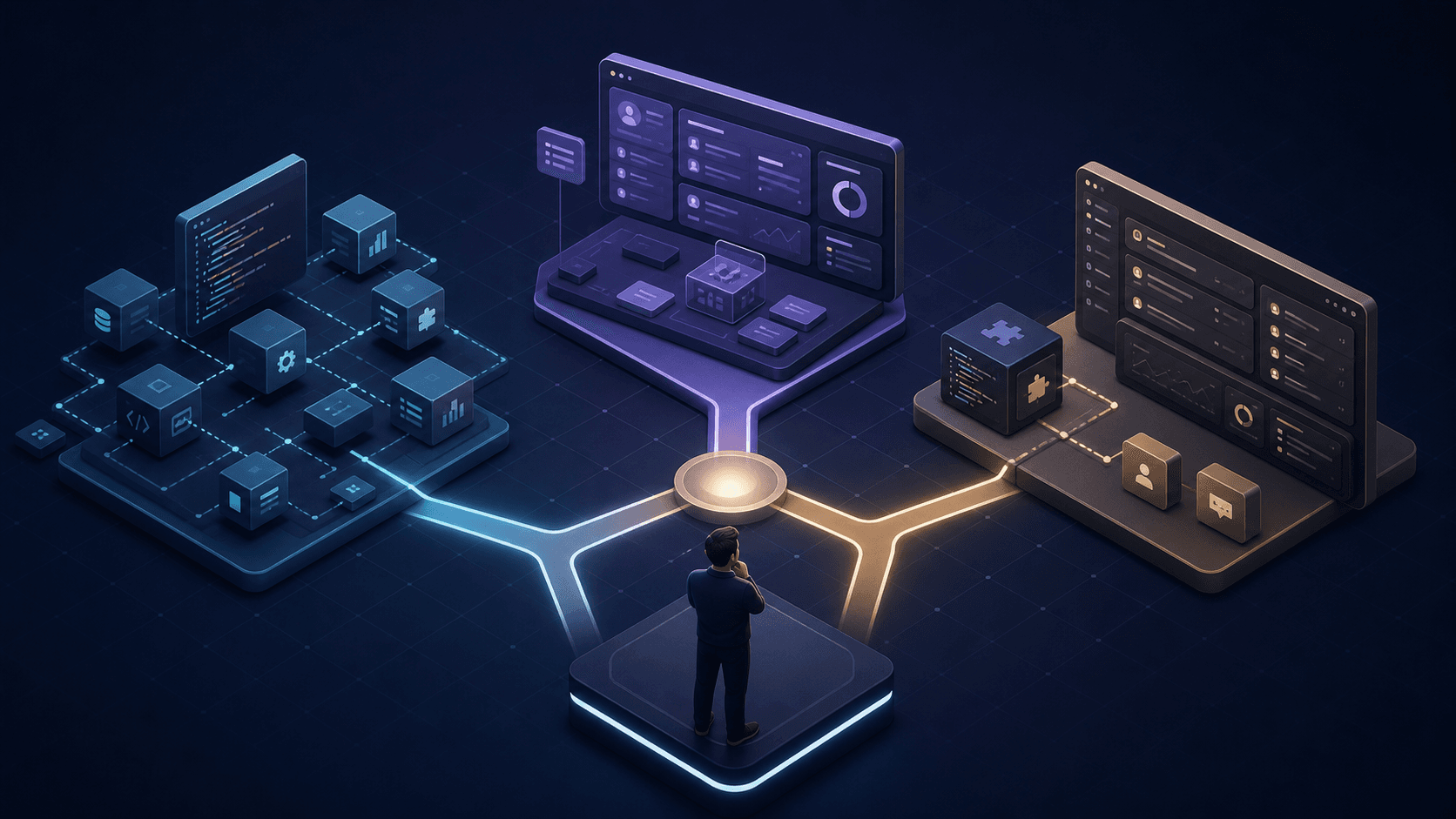
A build vs buy developer support platform decision is easy to oversimplify. A team compares a vendor subscription with a few engineering estimates, calls one option expensive, and moves on. The real choice is not a price tag versus a sprint plan. It is a decision about who will own a production system that receives customer data, connects support channels, interprets API contracts, controls automation, protects credentials, and stays useful as the product changes.
That system already exists in some form, even when nobody has named it. It may be a shared inbox plus internal scripts, a chat widget plus a general help desk, or a collection of docs searches and engineer escalations. Building replaces that improvised stack with software your team owns. Buying replaces part of it with a product and supplier relationship. A hybrid approach keeps differentiating workflows in-house while adopting a managed core for the repetitive platform work.
This decision framework helps developer-tools and API companies compare those paths on the same evidence. It defines the capability boundary, scores strategic fit, calculates total cost of ownership, tests trust requirements, and ends with a time-boxed evaluation. The goal is not to prove that buying or building is universally correct. It is to make the trade-off explicit enough that engineering, support, security, and finance can defend the same decision.
Define the Developer Support Infrastructure Boundary First
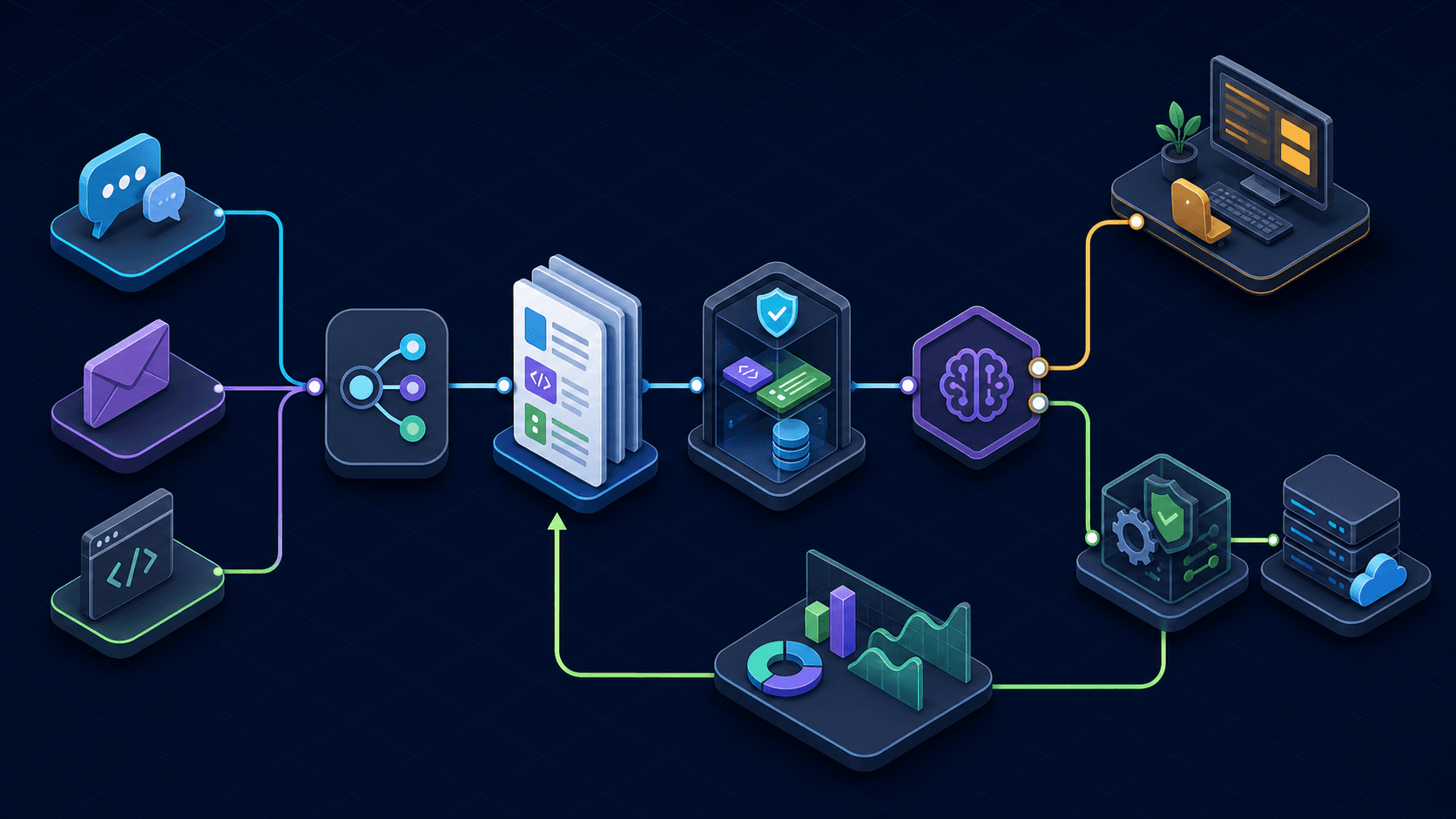
Begin by drawing the smallest complete system that can deliver the outcome. For API support, an inbox alone is not that system. A customer question must enter through a channel, attach to an identity and conversation, reach the right operator or automation, retrieve current technical evidence, protect sensitive data, preserve a handoff, and produce feedback that improves documentation or the product. Omitting one layer from the build estimate does not remove the work; it pushes the work into manual operations.
A useful boundary has seven capabilities. First is channel intake for live chat, email, community surfaces, or other supported routes. Second is the conversation model: messages, delivery state, assignment, priority, and history. Third is an API context pipeline that detects, parses, normalizes, chunks, refreshes, and retrieves documentation. Fourth is an automation decision layer with confidence, clarification, citation, and handoff behavior. Fifth is an operator workspace. Sixth is a guarded path for account-specific or live verification. Seventh is governance: tenant isolation, access control, redaction, retention, auditability, rate limits, and observability.
Write each capability as an outcome rather than a product label. For example, do not score whether a vendor has AI. Score whether the system can answer a schema question from current workspace evidence, cite the evidence safely, recognize insufficient context, and transfer the unresolved facts to a human. This phrasing makes a custom prototype and a commercial platform comparable. It also exposes integrations that merely move data without preserving the workflow the support team needs.
- Inventory the current tools, scripts, queues, and manual copy-paste steps inside the boundary.
- Name the customer and operator data that crosses each component.
- Record the owner, failure mode, recovery path, and update cadence for every capability.
- Separate required launch behavior from attractive future automation.
Score Differentiation, Fit Gap, and Reversibility
The strongest reason to build is not that engineers can write the code. It is that owning a particular capability creates a durable product or operating advantage that cannot be obtained through configuration, integration, or a replaceable extension. A proprietary diagnostic engine tied to unique telemetry may qualify. A generic inbox, message composer, webhook retry worker, role editor, or document crawler usually needs a stronger justification because its value comes from dependable operation rather than uniqueness.
Score strategic differentiation from one to five. A five means the capability directly changes why customers choose your product and requires knowledge or data only your organization can possess. A one means customers expect it to work but do not care who implemented it. Then score fit gap: how far the best acceptable product is from the workflow you actually need. A high differentiation score and a high fit gap support building. Low differentiation and a small fit gap support buying. Mixed results suggest a hybrid boundary.
- Build signal: the workflow is part of the product's differentiated customer experience.
- Buy signal: the capability is necessary infrastructure with well-understood behavior and costly maintenance.
- Hybrid signal: the core is common, but the evidence, policy, or customer-facing action is unique.
Calculate Total Cost of Ownership, Including Toil
Compare costs over a realistic operating horizon, usually three years, and use ranges rather than a single confident total. The build column starts with discovery, architecture, design, implementation, migration, and launch. It continues with hosting, monitoring, backups, incident response, security review, dependency upgrades, browser and provider changes, data migrations, deliverability, abuse handling, documentation, on-call ownership, and feature work. Include the opportunity cost of the roadmap work those engineers will not ship.
The buy column starts with subscription and usage charges, implementation, data migration, integration work, identity configuration, security and legal review, training, change management, and ongoing administration. Add expected costs for premium support, extra environments, retention, storage, API limits, additional channels, seats, and future migration. Buying transfers some engineering and operational responsibility; it does not eliminate internal ownership of configuration, process, data, or vendor management.
Google Cloud's Well-Architected guidance treats cost alongside operations, security, reliability, performance, and sustainability. That is the right shape for this comparison. A lower invoice can be a worse decision if the system consumes scarce engineering attention or misses the reliability target. Google SRE defines toil as manual, repetitive, automatable, tactical work that tends to scale with service growth. Use that test on the support stack: if the proposed build creates a growing stream of connector repairs, message replays, access fixes, and index rescans, put those hours in the model.
- People: build, operate, secure, administer, train, and support the system.
- Platform: infrastructure, storage, models, email, observability, backups, and environments.
- Change: migrations, API evolution, channel-provider changes, dependency upgrades, and policy updates.
- Risk: expected incident, delay, lock-in, switching, and opportunity costs expressed as ranges.
Evaluate Security Responsibility on Both Paths
A developer support system sits on a sensitive trust boundary. Customer messages may contain email addresses, request identifiers, payload fragments, configuration details, or credentials pasted by mistake. API documentation may include private URLs or adversarial text. Live verification may require stored authentication. Multi-tenant operation must prevent one workspace from retrieving another workspace's sources or conversations. These are architectural requirements, not a security questionnaire to complete after the commercial decision.
For a custom build, map those requirements to the software development lifecycle. NIST's Secure Software Development Framework recommends integrating secure practices throughout development rather than treating them as a final test. Your estimate therefore needs threat modeling, code review, dependency management, secure configuration, vulnerability response, logging discipline, recovery exercises, and an accountable security owner. An AI component also needs controls for prompt injection and sensitive information disclosure, both included in OWASP's 2025 LLM risk list.
For a purchased platform, replace implementation assumptions with due diligence. NIST SP 1326, finalized in July 2026, frames supplier due diligence around provenance, resilience, foundational cyber practices, ownership or control, and supply-chain tiers. Ask where data is stored, how tenant isolation is enforced, how secrets are encrypted and revealed, which subprocessors are involved, how access is audited, what happens during provider failure, how data can be exported, and how the supplier communicates incidents and material changes. Buying changes the evidence you inspect; it does not outsource accountability.
When Building Developer Support Infrastructure Is Rational
Build when the support experience is itself a core product surface and the differentiating requirements reach deep into architecture. A company may need an embedded workflow that acts on proprietary runtime state, a regulated deployment boundary no acceptable supplier can meet, or a unique collaboration model that would be damaged by translation into an external platform. Building can also be rational at sufficient scale when a named platform team has the mandate and budget to operate the capability for years.
A credible build plan names the first production slice, not a collection of mockups. It includes tenant boundaries, migrations, retry semantics, audit logs, retention, backups, observability, and on-call ownership. An AI layer also needs retrieval evaluation, citations, confidence behavior, redaction, prompt-injection defenses, provider-failure handling, and human escalation.
Avoid building merely because the first integration looks simple. Sending a chat message to a model is a demonstration, not a developer support platform. The expensive behavior appears in ambiguous identity, reordered webhooks, duplicate deliveries, failed attachments, stale sources, access changes, partial ingestion, deleted users, provider outages, and migrations. Build only when the organization wants to own those edge cases and the differentiation on the other side is worth that ownership.
When Buying a Developer Support Platform Is Rational
Buy when the required capabilities are important but not differentiating, a suitable platform satisfies the hard constraints, and time-to-learning matters more than complete implementation control. A managed foundation can let the team test routing, documentation coverage, agent behavior, operator workflow, and customer adoption while the vendor carries much of the common platform maintenance. The internal team can spend more time on API quality, diagnostics, documentation, and product fixes.
A purchase is only as good as the acceptance test. Evaluate real source formats, real channel shapes, realistic message history, a representative tenant model, and redacted failures. Ask the platform to show empty, loading, degraded, and handoff states—not only the happy path. Confirm export and deletion behavior, API coverage, rate limits, identity boundaries, recovery objectives, and how product changes are communicated. Read the contract and technical evidence together; neither a polished demo nor a security document alone proves operational fit.
Buying is a poor choice when a mandatory workflow needs brittle workarounds, required data controls are unavailable, or the supplier cannot provide enough evidence for the risk. Record those disqualifiers before demos so convenience does not gradually redefine the requirement.
Use a Hybrid Architecture to Keep the Differentiating Layer Small
Many teams should choose a hybrid architecture on purpose. Buy the operational core—conversation storage, channel adapters, operator workflow, access controls, retrieval plumbing, and routine administration—then integrate the proprietary evidence or actions that make your support exceptional. The custom layer might calculate an account-specific diagnostic, query an internal status service, attach a safe trace summary, or create a product-specific remediation. It should not duplicate the platform's message model unless that ownership is genuinely strategic.
Keep the boundary narrow and explicit. Use stable APIs and event contracts. Give each side a clear system of record, failure policy, and retry owner. Pass identifiers and least-privilege evidence instead of copying broad datasets. Keep credentials on the server side and return only the minimum redacted result. If the managed core is temporarily unavailable, define whether the custom action queues, fails closed, or routes to a human. If the proprietary service is unavailable, the support conversation should still remain intact.
Design reversibility before it is urgent. Maintain exportable conversation and source identifiers, document configuration outside individual memory, and avoid embedding vendor-specific assumptions throughout product code. Reversibility does not mean a cost-free migration. It means the organization knows what data, contracts, workflows, and verification tests would be required to change the core without rediscovering the system under pressure.
Run a 30-Day Build-vs-Buy Evaluation
Turn the framework into a 30-day evaluation rather than an open-ended debate. In the first week, inventory the current workflow and quantify a baseline: question volume by channel, common issue types, escalation rate, time spent finding technical context, repeated questions, documentation gaps, and hours of manual maintenance. The purpose is not to manufacture an ROI promise. It is to identify which work the new system must change and which costs already exist off the books.
In the second week, define ten to twenty acceptance scenarios from real, sanitized support patterns. Include an answerable endpoint question, an ambiguous auth failure, stale or conflicting docs, a credential pasted by mistake, a tenant boundary test, a channel delivery failure, a provider outage, an operator takeover, a deleted or changed source, and a data export. Score the custom design and shortlisted products against the same scenarios. Require evidence for each score.
Use week three for a thin vertical slice or configured pilot. Measure setup work, operator comprehension, retrieval relevance, clarification quality, handoff completeness, and failure recovery. In week four, update the cost ranges, name the owner for each component, decide, and set a six-month review date.
- Week 1: baseline the current system and draw the full capability boundary.
- Week 2: create shared acceptance scenarios and hard disqualifiers.
- Week 3: run a production-shaped pilot with sanitized evidence and failure cases.
- Week 4: compare TCO ranges, risks, ownership, and reversibility; then decide.
How Woes Fits the Developer Support Platform Decision
Woes represents the managed-core side of this decision for API-native developer support. The current implementation keeps live chat, email, and Discord as channel values over one workspace-scoped conversation and message model. Its API context pipeline detects and normalizes sources including OpenAPI, Postman, GraphQL, AsyncAPI, gRPC, and SOAP, then makes normalized endpoint and documentation evidence available to the operator workspace and support agent. OpenAPI itself is a machine-readable interface description standard; the support value comes from preserving its operations, parameters, schemas, examples, and surrounding explanations as retrievable evidence.
The agent is not treated as a separate support channel. It retrieves workspace context, assesses sufficiency and confidence, produces customer-safe citations, and clarifies or hands off when the evidence does not justify an answer. The implementation redacts credential-shaped text before model calls. Stored API authentication is encrypted separately from source content, applied server-side for guarded live verification, and omitted from browser-facing reads. Live calls require the customer to ask or confirm before the agent runs them, and returned context is redacted before it can support an answer.
Those capabilities do not make every build-versus-buy answer favor Woes. A team that only needs a broad CRM, has no API or technical documentation workflow, or requires a deployment model the product does not support should keep looking or build the constrained layer. A team whose repeated support burden comes from endpoints, auth, schemas, webhooks, SDK examples, and cross-channel troubleshooting can evaluate Woes against the acceptance scenarios above. The fair comparison is implemented fit, security evidence, operating cost, and ownership—not a feature-count contest.
The Bottom Line
A sound build vs buy developer support platform decision begins with the complete operating boundary and ends with named ownership. Build when the differentiating workflow justifies owning its security, reliability, migrations, and edge cases. Buy when a managed platform meets the hard constraints and lets the team focus on API quality and customer outcomes. Choose a hybrid when the common platform work can be managed while a small proprietary layer preserves the advantage that matters.
Whichever path wins, keep the same proof standard. Count total cost rather than visible price. Test degraded states as carefully as demos. Treat customer messages, API context, credentials, and model inputs as separate trust boundaries. Require retrieval, clarification, and handoff behavior to work on real support scenarios. Document how to leave the architecture before the organization is forced to. That discipline turns a familiar software debate into a decision the support team can actually operate.
Sources and Standards
This Woes article references public standards and developer documentation that shape API support workflows.
Related Woes Pages
Continue into the Woes product pages that connect this topic to API-native support workflows.
- Developer support platform
- API support platform
- API context ingestion
- Grounded AI support agent
- Unified developer support inbox
- Authenticated API testing
- Why developer support needs more than a help desk
- Why API support needs a context layer
- The modern API support stack
- Measure developer support automation ROI