API Documentation Drift: A Detection and Response Playbook
Use this API documentation drift playbook to detect contract mismatches, rank customer risk, repair the source of truth, and keep support evidence current.
Treat API Documentation Drift as a Contract Incident
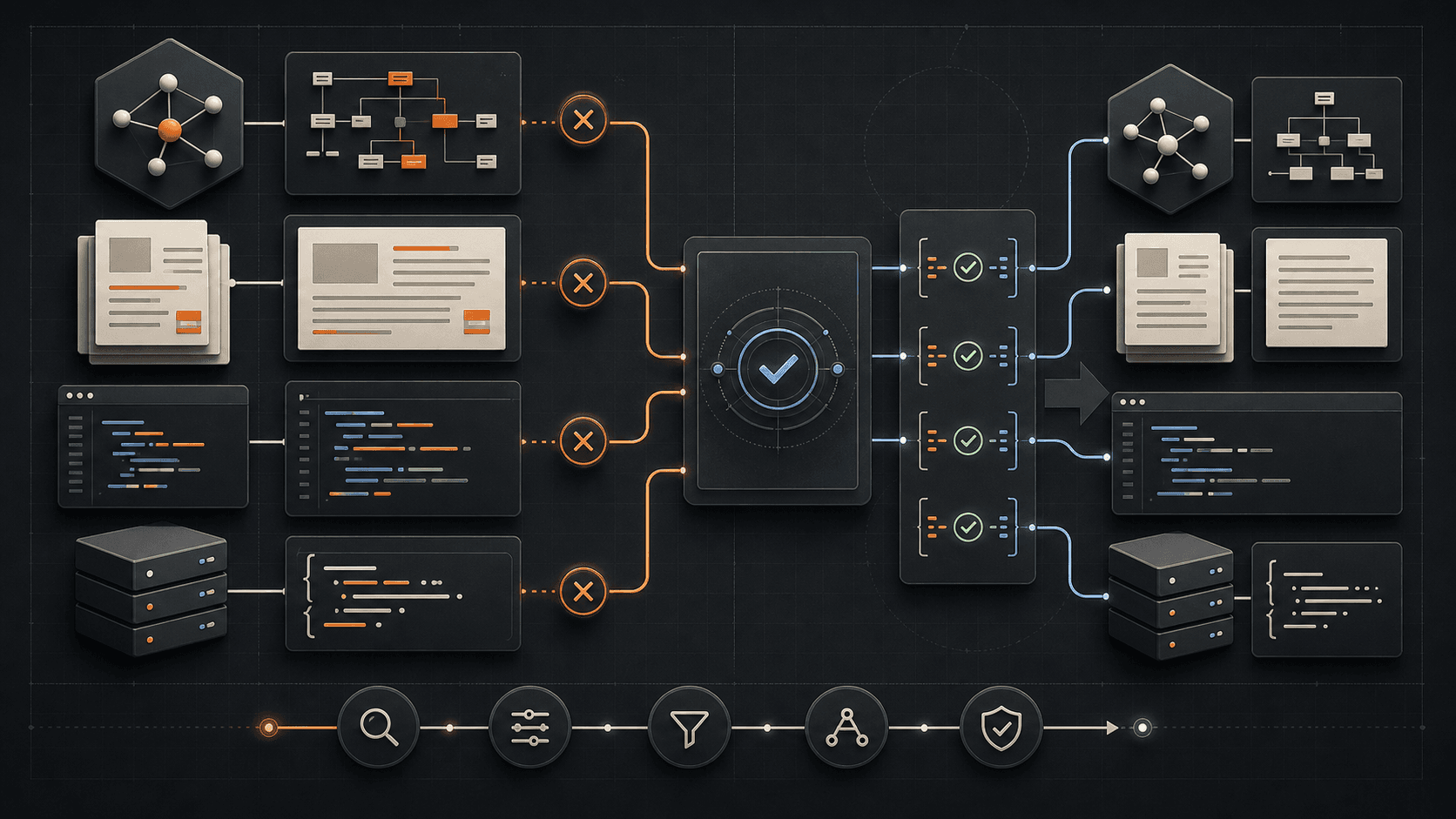
API documentation drift is the mismatch between the API developers actually call and the contracts, reference pages, examples, SDK guidance, changelog, or support material that describe it. The visible symptom might be a failing copy-and-paste example. The deeper problem is uncertainty: neither a developer nor a support agent can tell which representation is authoritative.
A useful drift program does more than regenerate a portal on a schedule. It detects meaningful differences before release, verifies a bounded set of behavior after deployment, classifies customer risk, repairs every affected representation, and preserves an audit trail. This playbook gives API platform, documentation, developer relations, and support teams one response model for doing that work without treating every text edit as an incident.
Create a Contract Ledger and Name the Authority
Begin with a contract ledger: a short inventory of every artifact that makes a promise about the API. Typical entries include the deployed routes, source annotations, OpenAPI description, public reference, tutorials, code samples, generated SDKs, Postman collections, webhook schemas, release notes, and internal support runbooks. Record an owner, repository, release version, generation path, and last verified time for each one.
Then declare an evidence hierarchy. For many teams, reviewed service behavior and its versioned machine-readable contract jointly define the release, while generated reference pages and SDKs are derived artifacts. That is a policy choice, not a universal law. A design-first team may make the reviewed OpenAPI document authoritative and block code that diverges. A code-first team may generate the description from route definitions. What matters is that a mismatch has a deterministic escalation path instead of an argument in the incident channel.
Do not call production traffic the source of truth without qualification. Observed traffic is evidence of what happened for selected requests, environments, accounts, flags, and versions. It may reveal undocumented behavior, but it cannot prove that every observed field is stable or supported. Pair runtime evidence with the owned contract and release intent.
Detect OpenAPI Drift Before Merge
The cheapest place to catch API spec drift is the pull request that introduces it. Produce a candidate contract from the change, compare it with the last released contract, and attach a semantic report to review. A semantic OpenAPI diff understands operations, parameters, request bodies, responses, schemas, security requirements, and references; a line diff mostly understands formatting. The oasdiff project, for example, exposes full diff, changelog, validation, and breaking-change modes for OpenAPI descriptions.
Fail by default when an operation disappears, an accepted request becomes invalid, a required field is added, a type changes, an enum value is removed, an authentication requirement tightens, or a documented successful response is no longer possible. Route ambiguous changes to an API owner. An added response enum value may be wire-compatible yet still break an exhaustive client switch. A new default may preserve the schema while changing what reasonable users experience.
Google AIP-180 separates source, wire, and semantic compatibility. Use the same three lenses in review. Can existing client code still compile against the new SDK? Can old clients still exchange valid messages with the new server? Will they continue to receive behavior a reasonable developer would expect? The third question catches drift that a schema comparison cannot settle alone.
- Validate the candidate contract and resolve references before comparing it.
- Compare against the exact last released version, not whichever branch happens to be convenient.
- Require an owner and migration decision for every approved incompatibility.
- Regenerate reference pages, fixtures, and SDKs from the approved contract in the same release path.
Verify Deployed Behavior with Guarded Probes
Pre-release comparison proves that two contract files differ; it does not prove the deployed server matches the candidate. After deployment, run small, deterministic conformance probes against a non-destructive environment. Check route reachability, authentication rejection shape, required headers, representative status codes, response media types, and a few schema invariants. Use synthetic accounts and known fixtures so account state does not masquerade as drift.
Keep the probe allowlist narrow. GET and HEAD checks are the safest default, but even reads can expose private data or trigger expensive work. Mutating checks need an isolated tenant, idempotency controls, cleanup, and explicit ownership. Redact tokens, authorization headers, cookies, signed URLs, customer fields, and response samples before results reach general logs or support tooling.
A 200 response is not enough. Validate the expected version, content type, required fields, status semantics, and documented examples. Conversely, do not infer that an undocumented field is automatically a breaking defect. It may be additive behavior that needs contract review, or an internal field that should be removed from the response. The alert should say what disagreed and what evidence was observed, not pronounce an unreviewed fix.
Monitor the Published Docs, Examples, and SDKs
Published documentation can drift even when the contract is correct. A stale build, failed deployment, cache, wrong branch, or manually maintained tutorial may leave customers reading the previous release. Monitor the public URL, not only the documentation repository. Record its canonical version marker, content hash, build commit, last-modified metadata, and links to the contract and changelog that produced it.
HTTP validators can reduce unnecessary transfers. RFC 9110 defines ETag and Last-Modified as validators that support conditional requests; a monitor can retain the previous validator and use If-None-Match or If-Modified-Since. A 304 indicates that the selected representation remains valid for that request. It does not prove semantic accuracy, so periodically compare parsed operations and sample content even when the page appears unchanged.
Monitor secondary artifacts independently. Compile or run quickstarts against their documented dependency versions. Validate Postman collections. Generate SDKs in a clean environment and run contract fixtures. Crawl tutorial links and code blocks. A perfect reference page does not help a developer who followed a two-year-old README example that still ranks first in search.
Triage Drift by Compatibility and Customer Risk
Severity should reflect customer impact, not diff size. Classify each finding by affected versions, environments, operations, clients, and evidence. A typo in an internal description is routine. A missing optional response field is usually low risk. A wrong auth scope, renamed path, new required input, changed type, removed enum, or silently different default can stop integrations and deserves urgent review.
Use four response levels. Critical drift creates security, privacy, financial, data-integrity, or broad availability risk and may require rollback or traffic containment. High drift breaks valid integrations or sends developers toward unsafe behavior. Medium drift causes repeatable confusion with a workaround. Low drift is inaccurate or incomplete without a credible near-term failure path. Add confidence separately: a high-impact suspicion with weak evidence needs rapid verification, not immediate public certainty.
The incident record should include the first bad release, last known good contract, customer-visible symptom, affected documentation URLs, SDK versions, probe evidence, owner, containment, and next update time. That turns a vague report that the docs are wrong into a bounded engineering decision.
Run a Focused Documentation Drift Response
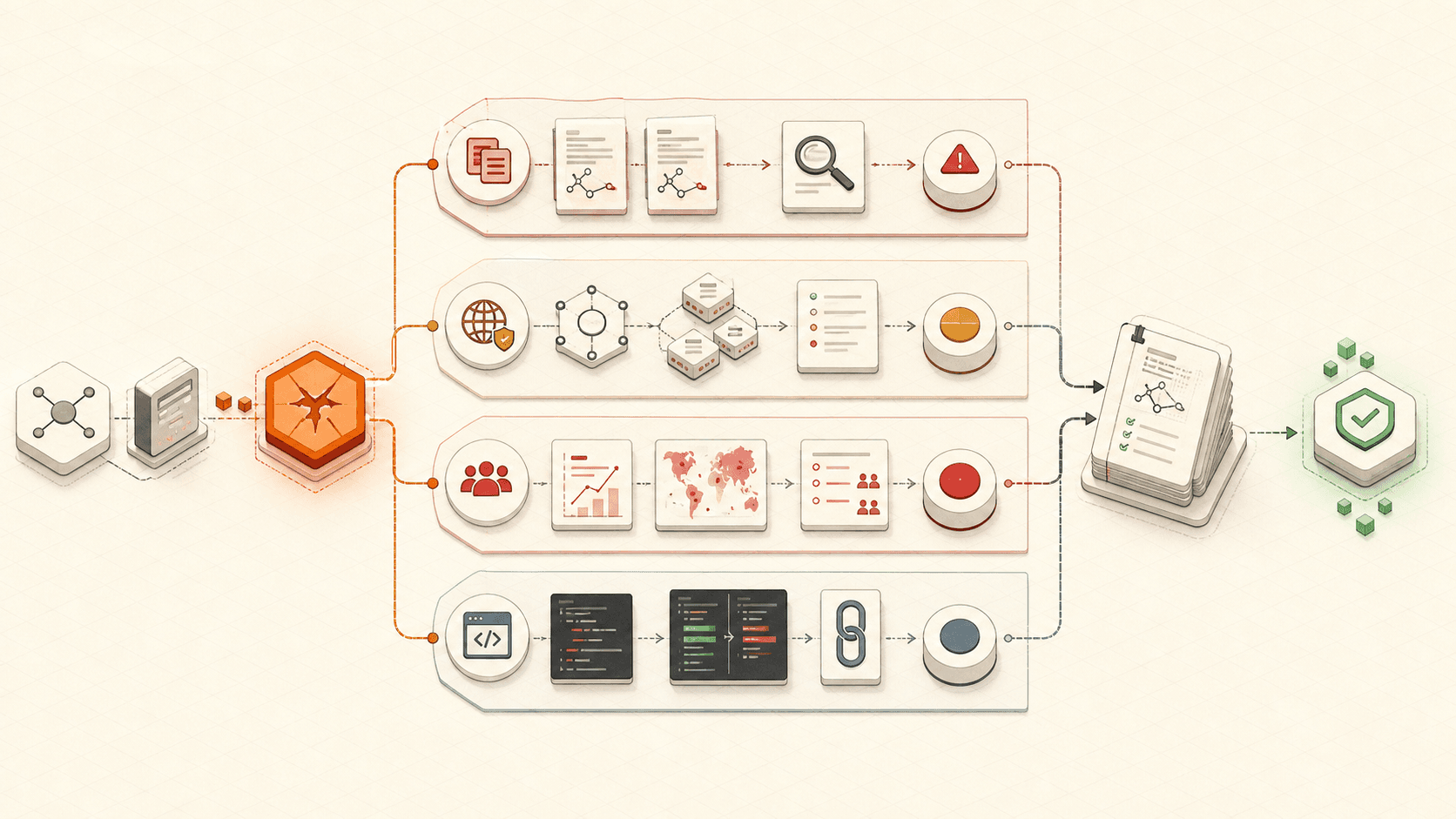
In the first response window, freeze automatic publication from the suspect source and identify whether the implementation or documentation is wrong. If a backwards-incompatible server change escaped unintentionally, rollback is often safer than editing the docs to legitimize it. If the intended contract changed, publish a precise warning and migration path while the complete documentation set is repaired.
Support should receive customer-safe interim guidance: affected operation and versions, observable symptom, approved workaround, what sanitized evidence to request, and when to escalate. Do not ask developers to paste API keys or complete production payloads. Prefer request IDs, timestamps, API version headers, redacted error bodies, SDK versions, and minimal reproducible requests.
Search every derivative surface before closing containment. A field rename may appear in the OpenAPI schema, reference page, JSON example, SDK type, CLI help, Postman request, tutorial, changelog, and canned support reply. Patch only the public reference and the next customer may still arrive through an outdated SDK example.
Repair the Generation Chain, Not One Page
Repair the earliest incorrect artifact in the generation chain. If route code changed without the design contract, resolve the product decision and update both under review. If the contract was right but the reference build used an old input, fix the pipeline and republish. If generated SDKs are stale, regenerate from the approved version and publish upgrade notes. Manual downstream edits create another branch of truth and guarantee a later recurrence.
Add a regression at the boundary that failed. Contract diffs cover structural changes. Consumer-driven or conformance tests cover behavior. Example tests prove snippets execute. Documentation build assertions prove the released version and canonical URL are visible. Support fixtures prove the corrected evidence is retrievable and produces a safe answer. Keep the smallest test that would have detected the incident before the customer did.
Close only when the authoritative contract, deployed behavior, published docs, examples, SDKs, changelog, and support evidence agree for the affected version. Record deliberately unsupported or implementation-defined behavior so the same observation is not repeatedly rediscovered as drift.
Separate Deprecation, Migration, and Sunset
Intentional change needs lifecycle signaling, not silent drift. Mark deprecated operations and schemas in the machine-readable contract, explain the replacement, publish tested before-and-after examples, and state which API versions are affected. Give SDK-specific migration steps when generated names or types change. A changelog entry that says improved response handling is not enough for a developer whose parser must change.
RFC 9745 standardizes the Deprecation response header and a deprecation link relation for human-readable policy. The specification is explicit that deprecation by itself does not change resource behavior. When a resource is expected to stop responding at a known time, the Sunset header from RFC 8594 can communicate that later boundary alongside Deprecation. Keep dates, version policy, runtime headers, OpenAPI markers, reference badges, and migration guides consistent.
GitHub's REST documentation offers a concrete classification model: removing operations or fields, renaming parameters, adding required parameters, making optional parameters required, changing types, and removing enum values are breaking changes released in a new API version. Your policy may differ, but it should be equally legible and testable.
Use Support and AI Signals as Drift Detectors
Support data is a drift sensor. Cluster tickets where a documented example fails, an expected status changes, a field is missing, authentication guidance conflicts, or an SDK behaves differently from the reference. Compare those clusters with release and documentation timestamps. A sudden concentration after one deployment is stronger evidence than a generic rise in ticket count.
AI support makes freshness more important because stale evidence can turn one outdated page into many confident replies. Retrieval should preserve source identity and version, reject operator-only or unsafe sources from customer answers, and route insufficient or conflicting evidence to clarification or handoff. Evaluation fixtures should pair old and new versions, include conflicting examples, and require citations that actually support material API claims.
Do not let the agent decide which contract is authoritative. Encode the hierarchy in source scope, version metadata, publication state, and runtime policy. During an incident, remove or quarantine the bad source, attach the verified interim guidance, and retest the exact customer question before automation resumes.
How Woes Keeps Refreshed Support Context Safe
Woes currently ingests OpenAPI, Postman, GraphQL, AsyncAPI, gRPC, SOAP, websites, raw documentation, GitHub, Confluence, and Notion into workspace-scoped sources, documents, endpoints, Markdown, and retrieval chunks. URL-backed sources can be rescanned through an authenticated, rate-limited route. The rescan re-runs auto-detection when appropriate, so format-detection improvements can correct a previous classification.
The storage path is replacement-safe: Woes builds the new source, inserts its children, marks it ready, copies stored API-auth configuration and agent attachments to the replacement, and only then deletes superseded versions. A failed ingest removes partial children but leaves a visible failed source record; it does not destroy the last good source. If a rescan normalizes to the same content hash, Woes returns the existing ready source and avoids inserting and re-embedding identical chunks.
The repository also includes a CRON_SECRET-protected maintenance route that refreshes eligible URL-backed context on a 48-hour cooldown, synchronizes the default agent to ready sources, and re-tunes agents with attached context. These features keep support evidence fresher, but Woes is not a substitute for a pre-merge semantic contract diff or an API owner's compatibility policy. The upstream release system should catch breaking changes; Woes should consume the reviewed, current evidence and make source state inspectable to operators.
Launch the Playbook in 30 Days
In week one, build the contract ledger and pick one externally important API. Name the authoritative artifacts, owners, released baseline, compatibility rules, and public version marker. Inventory every derived reference, tutorial, collection, and SDK. In week two, add validation and semantic comparison to pull requests, with a documented approval path for ambiguous and intentional incompatibilities.
In week three, deploy guarded conformance probes and published-doc monitors. Start with a few read-only operations and synthetic fixtures. Record ETag or Last-Modified validators, content hashes, build commits, and probe results without storing secrets or customer payloads. In week four, connect support labels and AI evaluation cases to the same taxonomy, run a simulated high-severity drift incident, and measure time to authority, containment, complete repair, and verified closure.
After thirty days, expand by risk rather than endpoint count. Cover auth, money movement, writes, webhooks, pagination, rate limits, and widely used SDK paths before obscure reads. Review approved exceptions monthly. The goal is not zero differences; it is zero unowned, unexplained differences that can mislead a developer.
- One released contract is retained as the comparison baseline.
- Every breaking or ambiguous diff has an accountable reviewer.
- Production probes are bounded, redacted, and version-aware.
- Published docs and derivative artifacts expose a verifiable release identity.
- Support and AI regressions preserve every meaningful drift incident.
Make Freshness a Release Property
API documentation drift becomes expensive when teams discover it one customer at a time and repair whichever page was reported. A durable program defines authority, compares contracts before merge, verifies deployed behavior safely, monitors the published experience, and repairs the entire generation chain. Compatibility policy tells reviewers which differences matter; incident practice tells everyone what to do when one escapes.
Make the contract version observable, keep probes narrow, preserve last-known-good evidence, and treat support questions as signals rather than isolated interruptions. When code, contracts, docs, examples, SDKs, and support context agree, developers spend less time proving which reality is real—and the support system can answer from evidence it is entitled to trust.
Sources and Standards
This Woes article references public standards and developer documentation that shape API support workflows.
Related Woes Pages
Continue into the Woes product pages that connect this topic to API-native support workflows.